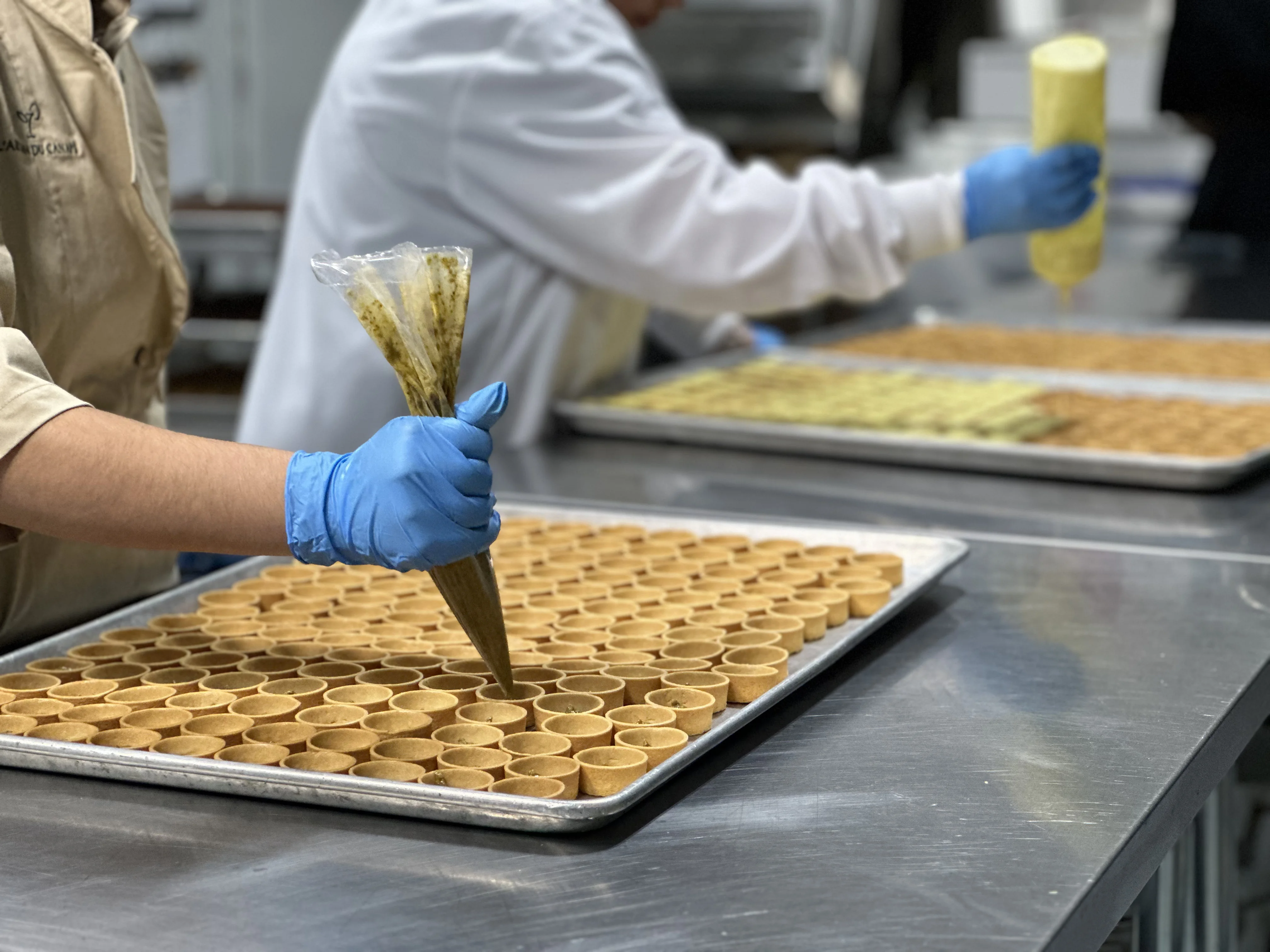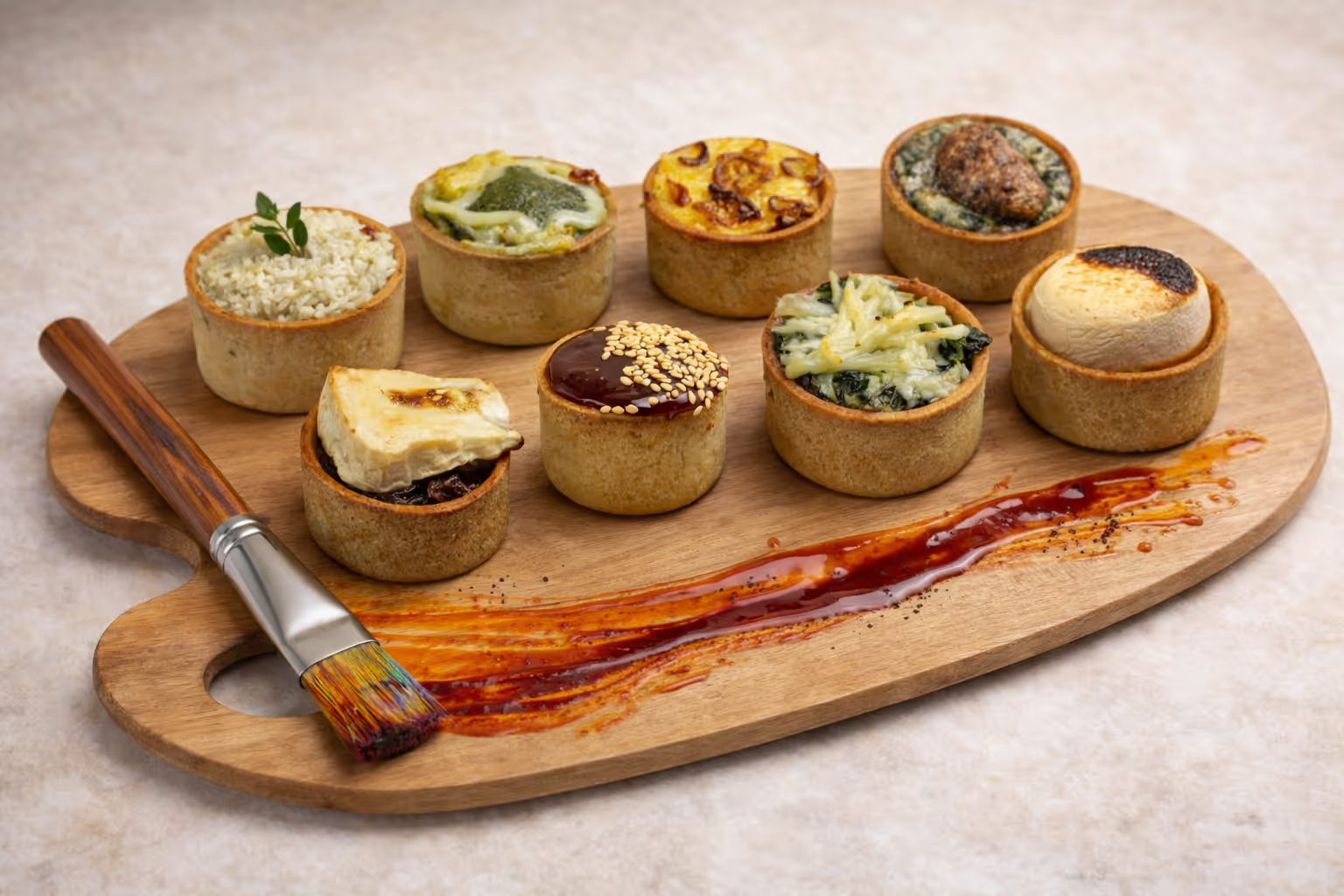
In premium foodservice, handmade hors d’oeuvres are often associated with craftsmanship, quality and a more refined presentation.
But for a restaurant, hotel, caterer or distributor, “handmade” should not be treated as a guarantee of quality on its own.
A handcrafted product is not automatically superior to one produced at a larger scale. Likewise, mass production does not automatically mean poor quality.
The more useful question is: which production method delivers the right balance of flavour, presentation, consistency, flexibility and operational efficiency for your business?
Understanding these differences helps foodservice buyers choose products that genuinely support their positioning rather than relying on labels alone.
1. What Does “Handmade” Really Mean for Hors d’Oeuvres?
In food production, handmade can describe different levels of manual work.
- shaped by hand;
- filled manually;
- hand-assembled;
- individually garnished;
- or hand-finished before packaging.
For this reason, buyers should look beyond the word itself and understand which parts of the production process actually involve craftsmanship.
With canapés and small-format hors d’oeuvres, manual work can be especially visible during assembly and finishing. Positioning a garnish, layering several ingredients, folding pastry, arranging a topping or finishing individual pieces all require a different type of attention from a fully automated process.
Handmade Does Not Have to Mean Inconsistent
Some natural variation can occur when products are assembled manually. But professional craftsmanship should still deliver consistency.
A hotel or caterer presenting dozens of hors d’oeuvres on the same tray needs pieces that remain sufficiently consistent in size, filling and overall appearance. The goal is human craftsmanship within a controlled professional standard.
2. Handmade vs Mass-Produced: What Should Buyers Compare?
Price alone does not provide a useful comparison. Several factors matter when evaluating the two production models.
Finishing and Presentation
Manual production can allow greater attention to details such as:
- assembly;
- garnish placement;
- layering;
- shaping;
- decoration;
- and final appearance.
Consistency
Large-scale automated production can be highly effective when the priority is reproducing an almost identical product in very high volumes. Handmade production can also achieve strong consistency when proper standards and quality controls are in place.
Flexibility
Manual production may offer greater flexibility for certain recipes, assortments, shapes or finishing requirements. A highly automated production line, by comparison, is generally optimized to reproduce the same product efficiently at scale.
Cost and Scale
Handcrafted products naturally involve more human labour. They should therefore not automatically be expected to compete with highly automated products on unit cost. For simple products purchased in very large quantities, mass production may be the most rational model.
The useful question is not simply whether every two pieces are identical, but whether the level of variation is appropriate for the operation’s presentation and service.
3. When Does Handmade Add Real Value to Premium Foodservice?
“Premium” can become just as vague as “handmade” if it is not tied to something tangible. A product does not become premium simply because someone touched it during production. Craftsmanship needs to create a noticeable difference.
When Presentation Matters
At a cocktail reception or banquet, guests often see an hors d’oeuvre before they taste it. Proportion, layering, garnish placement and finishing all contribute to the perception of quality.
When the Product Has Multiple Components
Some appetizers require more than simply filling a shell or portioning a mixture. Layering textures, folding pastry, positioning individual components or adding a delicate finishing element may benefit from manual preparation.
When the Experience Should Feel Less Generic
Premium hotels, caterers and event venues often want their food offering to reinforce the quality of the overall experience. The goal is to maintain professional consistency without creating an overly generic impression.
4. Can Handmade Hors d’Oeuvres Also Be Frozen?
Yes. Handmade and frozen describe two different aspects of a product.
Handmade refers to how the product is prepared, assembled or finished. Frozen refers to how it is preserved and distributed after production.
A hors d’oeuvre can therefore be shaped, assembled or finished by hand and subsequently frozen for professional storage and distribution.
Choosing frozen hors d’oeuvres does not necessarily mean choosing a fully automated product. Professional kitchens may want both careful preparation before the product reaches them and a practical format for inventory and service.
Restaurants, hotels and caterers should therefore assess a frozen appetizer based on how it performs after preparation, including its flavour, texture, appearance and consistency, rather than judging craftsmanship solely from its storage format.
5. Which Production Model Is Right for Your Foodservice Operation?
There is no universal answer. The right choice depends on the role hors d’oeuvres play in your guest experience.
If your priorities are primarily:
- lowest possible unit cost;
- very high volume;
- extreme uniformity;
- and standardized availability;
large-scale production may be entirely appropriate.
If your priorities place greater emphasis on:
- finishing;
- presentation;
- product complexity;
- flexibility;
- and premium perception;
handmade or handcrafted hors d’oeuvres may be a better fit.
For an upscale foodservice operation, the objective is not to choose the production method that requires the most labour. It is to choose the method that creates the most relevant value for the guest.
L’Artisan du Canapé’s Handmade Approach
L’Artisan du Canapé places craftsmanship and careful manual preparation at the heart of its approach to premium appetizers and hors d’oeuvres. The objective is to combine handmade finishing with the consistency required by professional foodservice, serving restaurants, hotels, caterers, distributors and other professional buyers.
The range includes handmade hors d’oeuvres and canapés, frozen products and ready-to-fill solutions for different foodservice applications.
6. Frequently Asked Questions
What are handmade hors d’oeuvres?
Handmade hors d’oeuvres involve meaningful manual work during preparation, shaping, assembly or finishing. The exact level of handcrafting can vary depending on the product and manufacturer.
Are handmade hors d’oeuvres always better?
No. Handmade production does not automatically guarantee quality. It adds value when craftsmanship improves the product’s finishing, presentation, flexibility or overall guest experience.
What is the difference between handmade and mass-produced appetizers?
The main difference is generally the production process and scale. Handmade products involve more direct manual work, while mass-produced products may rely more heavily on automation and standardized high-volume processes. Both can achieve high quality when appropriate standards are applied.
Can handmade canapés be frozen?
Yes. Handmade describes the production or assembly method, while frozen describes the preservation format. A canapé can be assembled and finished by hand before being frozen.
Why choose handcrafted hors d’oeuvres for premium foodservice?
They can be particularly valuable when detailed finishing, presentation, complex assembly and visual perception are important parts of the guest experience.